Wednesday, August 18, 2010

Captain Geography (AKA Miss India) Finds Cake


And now for something completely different. My new beautiful friends at Navdanya made a special going away present for those of us leaving the farm in the coming days: a scavenger hunt!

I am pretty sure the whole point was to get us to dress up in silly costumes and do silly things so that we could kill ourselves laughing. Well, they nailed it. Our costumes, on the orders of our scavenger hunt masters, were to be collected from one article of clothing from all the interns. Mine consisted of a cape with a map of the world on it (from Hannah) and a turban (from Raquel) which I tried to wear like the women from heaven in Garhwal. Glasses from Abhyudia. Sweaty sock from Julia. One sandal from Kamal. One flip flop from Rachel (who has very small feet). I named myself Captain Geography, but Sunil, bless his heart, said I looked more like Miss India. The treasure at the end of the hunt was a banana spice cake that my darling friends had lovingly and secretly prepared earlier in the day.


We made it to the cake just in time for the dinner bell to ring. Since I had already made sure there were plenty of Indian sweets to go around, we proclaimed it saved for breakfast.Yes. Cake and chai for my last breakfast here. I couldn’t ask for anything more indulgent.

Part of the reason for our late start was because Sunil and I took a late afternoon stroll to the Indian sweet shop to get a kilo worth of sweets for everyone on the farm. Indian sweets are like nothing else in the world. Almost all of them are composed of milk that has been boiled until solid, sweetened with cane sugar and studded with pistachios, almonds, cashews, etc. You get the picture. They are pretty hard to resist.

I think the best Indian sweet came from him though. He climbed a tree and picked two guavas, perfectly ripe. Sweetest of all sweets--shared with me by a new and loyal friend, picked fresh from a tree organically tended and enjoyed on my last walk through the mango grove.

And so, my time at Navdanya ends as it began. In the kitchen, sitting in a circle sharing food, lots of jokes and laughter and genuine affection. We cross many geographies and histories, all of us brought together over a meal and a shared passion for the doing the right thing with food, the earth and each other.


Good bye, Navdanya. I miss you so much already.

Sunday, August 15, 2010

Faces of Navdanya


Hannah from Canada, intern


Sunil, field worker


Abhyudai from India, intern


Raquel from Spain, volunteer


Satya, master chef


Kamal, food artist


Sheela, field worker


Massi from Italy, volunteer


Jai Singh, field and kitchen worker


woman farmer


Sumi


Suwan


Kieran from Italy, volunteer


Gloria from Italy, volunteer


woman and son at the farm where we get milk


Bean, puppy

Saturday, August 14, 2010

Notes to self, re: India, attn: Rishikesh


Do bring your cell phone charger, batteries you charged the night before and sensible shoes.

Don’t just agree to go on a “walk” to a waterfall without asking if sensible shoes are required. This is especially important if you have not brought sensible shoes with you.

Do bring your own laundry soap. Failing that bring Benadryl for the allergic reaction you will have from whatever is in laundry soap in India.

If you have not brought your own laundry soap and have recently washed your pants, take them off before bathing in a waterfall. Take Benadryl anyway.


Do let a waterfall in the Himalaya be really worth a little bit of misery.

Do eat yak cheese sandwiches.


Do eat ghewar (Garhwali cake) and masala (spicy) tea for breakfast.


Don’t eat Chinese food.

If you must eat Chinese food, find fantastic, bombastic company and a restaurant with an outdoor terrace and watch the first day of the new moon set over the Ganga.


Allow strangers to show you the way.

Meet old and new friends in the middle of the bridge.

If you believe in the power and mystery of the Ganga, allow peace to live.


Return to love.

Wednesday, August 11, 2010

Peak experiences

Two days ago, Hannah, Abhyudai and I, had the tremendous privilege of traveling with Dr. Shiva and some other scientists here at the Navdanya to a village for a meeting of women farmers in the Garwali Himalaya. My vocabulary of superlatives isn’t big enough to adequately describe this experience. And saying it was amazing, is simply stating the obvious. It was beyond wonderful, and a little hard to digest, if not summarize in a blog post. I’ll do my best.

Traveling with an international figure (who, by the way, doesn’t have a assistant, and answers her phone personally) was an experience all in itself. There was a recent oil spill near Mumbai and floods in Ladakh, and Dr. Shiva, when she had reception in the mountains constantly took calls from the media about these recent events. She explained in her own special way, that I characterize as unrelenting outrage, how the world was going to hell because of climate change, loss of biodiversity and chemical farming. I liked this part a lot. When she wasn’t on the phone she bombarded us all with ideas about how to change the world. This part almost put me in a catatonic state.

In a welcome break from these rather esoteric mental exercises, we stopped suddenly when Dr. Shiva pointed to an especially nice (and accessible) example of intercropping. Intercropping is an ancient technique for preserving biodiversity, farmland and conserving space. It is practiced all over the Himalaya, and in this example we found something even more interesting. There were two botanists in the car who, along with Dr. Shiva, have probably seen (and collected seeds from) every variety of millet grown in India. They found in this field a variety they had never encountered before. Excited conversations were held in (extra) rapid-fire Hindi with the owner of the plot, samples were collected and plans were made to come back in a month for the harvest. I think I might have swooned at one point.

Or maybe I was carsick. Our six hour journey to Uttarkashi (on the first day) involved an infinity of twists and turns on narrow mountain roads, which our driver took with an extra spurt of speed giving those of us in the back of the van whiplash about ten times a minute. I think every cell in my body has been relocated to a new and uncomfortable place. But on the second day, when we climbed even higher into the mountains, my discomfort turned to enchantment. Civilization fell away, cars disappeared from the road, streams gushed down the steep slopes and splashed across the roads and ancient trees grew out of rocks. It felt like we were disappearing into the mists of time, going back to the source, the origin.


In a way we were. The source of the Ganga is here in these hills (only another 4000 feet above where we were at a mere 8000 feet) and we followed one of its branches to this village. India is home to the world’s oldest civilizations, and the Ganga is the source of all life in this region. Time suspended for me as I watched the velvet green terraced hillsides slide by us, and I secretly wished the journey would never end. But end it did, abruptly at a village seemingly untouched by modernity. The women gathered to meet us wore their traditional clothes and their finest gold jewelry given to them at their weddings, sang their old songs and shared their ancient seeds. If I had been left there to die in their arms, I would have died happy. The only thing that got me back into the car to leave was a promise made to me by them, and to myself that I would come back one day.

They welcomed us all with turmeric and vermillion for our foreheads, garlands and flowers, touched our feet (a tremendous honor reserved for elders) and fed us tea and traditional foods. In the hour that followed they shared their concerns about the erratic rainfall they were experiencing. That had forced them to save five times more seeds (bija) because their crops were failing. They were grateful to Navdanya for helping them to set up a seed bank that gave them more collective security. That simple thing allowed them to avoid buying hybrid seeds which would put them in debt and not allow them to keep their seeds for the next year. My heart burned to think about this way of life teetering on the verge of extinction by destructive forces and machine mentalities completely beyond their control.

To say these women are beautiful is a serious understatement, and sells a bit short their courage, their dedication, their generosity and sweet humor. Their faces are lined with time and by the sun, but their hearts sing with pure joy, and they all shine with health, pride and vitality. I felt incomplete as a human being in their presence. I am so occupied with things that don’t matter at all. So invested in things that are ephemeral and don’t last. And in so doing contributing to the very forces that threaten this paradise. I can only hope to find the courage and strength to follow, teach and live peace, justice and ecology in every moment I take a breath.

In spite of the extra burden on seed saving due to their lack of rain, when I picked up a few seeds of millet that had spilled out of a bag to save, they gave me a sample of all their millet, amaranth, sesame and soybean with pure hearts, pride and joy. The gift could not be refused, and I accepted it with tremendous humility. I hope I can “be the bija” and plant seeds of hope for a more gentle society in my own world.

Strangers at the door, we departed as kin, with hugs that express all the saudad a person can feel at farewell. Strong, work worn hands clasped our heads and our cheeks touched, both sides. Hand to the heart, and fingers lifted to lips in a kiss. Love remains, joy lives forever.

Sunday, August 8, 2010

Many hands make joyful (if smelly) work

In India, almost all work (kam, in Hindi) is done collectively. Usually with a large group of family members in the case of the many families I’ve seen planting rice. Or with extended family or friends in the case of the local markets or repair shops. Or in the case of Navdanya, virtual strangers from all over the world who have become fast friends. It is strange, now, for me to see someone working alone, and makes me think about the work my mother did alone most of the time on our farm. And about the way we shared heavy jobs like wood cutting, butchering and haymaking with friends and neighbors.

The way work is organized at Navdanya is very random, and we volunteers generally just go out to some field and find what is being done and pitch in. This can make for some very interesting surprises, as I found out yesterday. I went out with Hannah to the fields behind the seed bank and found Sunil, the Rachels (there are three here right now) and Babaloo carrying cow dung into the vermicomposting shed. Hmmm.


Well, this is the work to be done, so we did it. The pile of cow dung had been sitting for about a month and was pretty ripe. Sunil and Rachel were carrying it with a makeshift “stretcher” made out of a burlap sack and two poles. Babaloo shoveled and two of us took turns carrying it into the shed and dumping it into rows. It very heavy, smelly work and it was quite hot, but there was a lot of light-hearted black humor about filling the “beds” in the “hospital” with the patients we were carrying on the “stretcher.” There was also some impromptu Hindi lessons with Sunil about taking the stretcher of cow poo AKA the patient to kamra number saat, che, panch, char…, (room number seven, six, five, four…).

Then came the even more fun part. When all the “patients” were arranged, with about five stretchers worth of cow dung, they are shaped, by hand, um yes… by bare hand… into neat heaps and then the worm filled “starter” is piled on top. Cow dung is actually thought to be antiseptic and sacred in Ayruvedic medicine, and is burned during weddings and other rituals. It is used to retard mold growth on the walls of rooms, including the one I am leaning against while writing this. So I stopped worrying and learned to love the cow hooie…on my hands, feet, pants, face... When we finished our smelly job, we covered the cow dung heaps with burlap sacks. The piles will then be watered weekly to keep the worms happy and hydrated. After 45 days the compost is finished and spread on the fields. And the process is started over again.


After our work the Rachels and I washed in a small stream, until Sunil beckoned us over to a shallow well filled with water, temporarily, for washing. Rachel from Spain stuck her foot in it, and from the look on her face, it was obviously divine. We all sat down on the edge and put our feet in the well and took a nice long post-cow dung soak in our makeshift spa. Amidst a lot of giggling and joking, Leeatt from Israel brought us chai while we soaked our feet like rural royalty having a country pedicure. Complete with cow dung. Not a bad way to spend a morning, really.


While soaking my feet, I reflected a bit on how an American farmer would do this heavy work. Alone, with a wheelbarrow and it would take five times as long. And feel five times longer too without the joking, laughing and learning. Not only was there about seven of us sharing this work, there was the work of the cows and the worms who start and finish the job to make the soil for the organic fields. Together , this community of beings all did their part to make hard work easy and exhausting work joyful, so that we can grow food in healthy, rich soil—the source of all life.

My new favorite food

Unfortunately, the season for greens is decidedly NOT NOW in India. Since we eat seasonally here on the farm, we eat a lot of rice, dal and chapatti for our meals, with only the occasional okra, (picked fresh from the vast field of it behind the kitchen) to break up on the monotony. I’m not a fan of okra to begin with, and having it pressure cooked turns it into slimy mush. Having it twice a day for a few days in a row was a bit much even for this vegetable lover. The interns and volunteers do a lot of dreaming out loud about spinach and kale.

Okra is occasionally replaced with a vegetable called “bitter gourd”, which is a pimply looking cucumber- like thing that people have variously described as tasting like “nail polish remover” and “paint thinner”. They weren’t kidding when they named it bitter gourd. It’s also supposed to be capable of curing diabetes and Satya hinted around at making a juice out of it for me. I said no, thank you. I’ll take my shots.

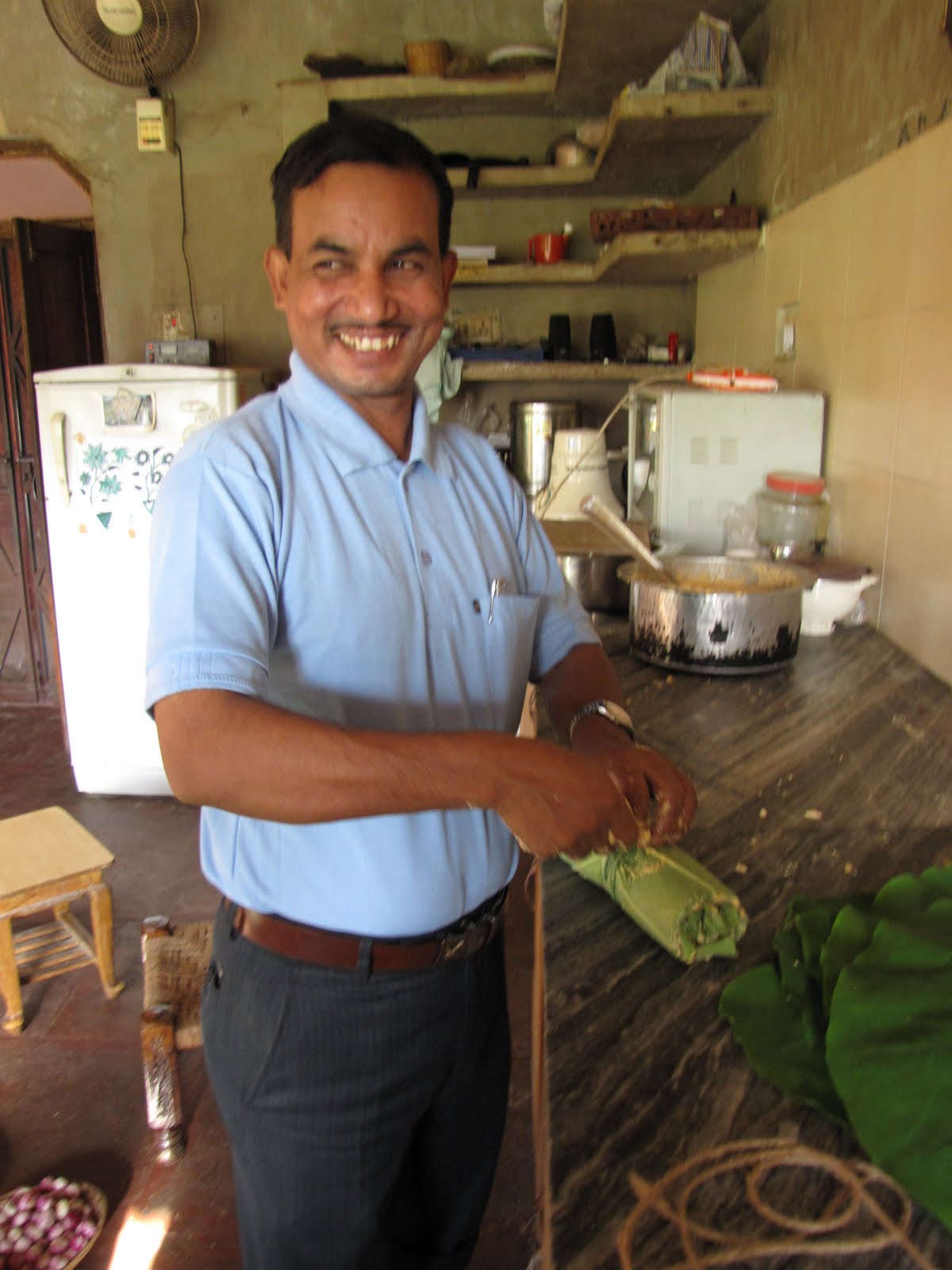
So when “patol” or “patra” was being prepared in the kitchen, we all got a little excited. Patra is stuffed taro leaves (also known as cassava, yucca and tapioca, in Africa, Latin America and North America, respectively) that are steamed and fried. The beautiful big taro leaves (which I think look like elephant leaves) are picked (this day by me and Sheela) and trimmed and folded around a chickpea and rice paste. The filling is made chana (chickpeas) and chawal (rice) that have been soaked and ground and seasoned with lots of sour mango powder (amchur), loads of garlic, red chili, garam masala (a mix of hot spices), salt and pepper. The paste is spread over the leaves in layers four or five deep which are then folded, rolled and tied with a stem of lemongrass. The process of making them is fragrant, messy and wonderfully participatory and hands-on.


The taro leaf rolls are then steamed, and if eaten for breakfast the next morning, are sliced and reheated by frying. They are served with a sauce of the chickpea paste. I am told that this is Dr. Vandana Shiva's favorite dish, and so we were treated with this for her recent visit here. It was a humbling pleasure in so many ways to participate in the harvesting, preparing and sharing of this delicious, unique food with such a tremendous woman.

Friday, August 6, 2010

Weeding and the Spirit of Fukuoka

Everywhere on this trip (in Belgium, Portugal and India), I have met people talking about the book One Straw Revolution written by a Japanese man by the name of Fukuoka. I had never heard of this book or this visionary man, until I started this journey. Cyrille in Belgium first told me about it in the Soul Food bar, and then Yve talked about it in her urban garden, and Sreedhara described the beauty of Fukuoka’s system in the back of a jeep during a long ride between Pachmarhi and Bhopal. In the penultimate full circle, I write this now, in the heat of a monsoon night, across the yard from a house built in honor of this man. And while cataloging Navdanya’s seed bank I found rice varieties that he preserved and shared for the future of farming.

Fukuoka’s ideas are revolutionary, and rest on four basic principles: 1) no plowing, 2) no fertilizer beyond a little chicken manure and green manures, 3) no weeding and 4) no dependence on any chemicals. Sprinkled in with this is a fair bit of beautiful prose about nature and landscape, Taoist philosophy, natural diets, stories, jokes and just plain common sense. It makes for a fast, pleasurable and inspiring read. I found it free online (and you can too) here: http://gyanpedia.in/tft/Resources/books/onestraw.pdf Run, don’t walk, toward reading this book. I have no doubt that it will change the way you think about food and farming.

It has permanently changed the way I think about weeding, which has created some ethical and epistemological problems for me here, since we do a lot of weeding right now on Navdanya’s farm. The season of rice planting has just finished, and now we wait for harvest. And weed. Fukuoka refers to his farming as “do nothing” farming. Which doesn’t mean he literally does nothing, but he has created a system of intercropping that makes for much less work. He lets his “weeds” do the work of ground cover, soil building and fertilizing, which is a basic principle of permaculture and biodynamic farming.

For example, Fukuoka intercrops wheat, rice and white clover—the seeds of which are all sown at the same time. The wheat germinates and grows while the rice grains wait for rain. After the wheat is harvested, the field is flooded, either by irrigation or by rains (Fukuoka’s preferred method). The white clover is easily mowed (and makes mulch)after the wheat harvest. It is weakened enough by the short flooding of the fields so that the rice will germinate and grow above the clover. The clover is a nitrogen fixer, so the “weeds” he has planted, actually put back what the rice and wheat take out. A perfect, renewable system. Read more from him about vegetables and fruit orchards, please...

Fukuoka’s argument against plowing and weeding is simple. The act of turning the soil actually brings weed seeds to the surface, and bare soil is literally begging for cover. What we call weeds are actually plants highly adapted to growing quickly to protect the soil. We can do the same by planting things we want to grow in between our crops, or use mulches, both of which Fukuoka uses in his systems. I now think of bare ground as a wound, and find ways to sneak the weeds we pulled back over the bare ground. When I find myself a part of a team that is weeding, I say a little apology for the soil and try to think of ways to stop this madness.

I (temporarily) convinced Jai Singh of the effectiveness of mulch while we were weeding the flower garden. Some weedss had dried in a pile for a few days. Underneath, the soil was weed free and moist. The soil around it was dry and had already sprouted weeds. I suggested we arrange the pulled weeds around the flowers. He shrugged as he does often, and shook his head in that characteristic way that Indians do when they do and don’t agree, maybe, maybe not, koi bhatt nahin (It’s nothing). And then agreed to try out what I suggested, I think only because I was a minor pain in his ass about it. Nevertheless, a small victory.

Fukuoka argues convincingly that it is the appearance of a weed free patch of ground that makes us think the plants are healthy and more productive. In other words, we perceive this “weed-free” system to be better. His experiments with a variety of mulches and intercropping indicate that plants actually thrive and produce more when they are surrounded by other plants. They are not robbed of nutrients by competing plants; rather they are enriched by their mysterious associations in the soil.

In case I have painted a dim picture of Navdanya’s methods, I must say that not all the farming/gardening operates under the influence of a weed-free worldview.

Today I helped Sheela pick taro (also known as cassava, yucca, tapioca…) leaves for a delicious dish, I um, yum, love, but the name of which I have yet to nail down. (The word I thought it was turns out to be an insult in Hindi. Hello, learning curve. Look for future blog posts on this, never fear, after I get properly educated.) So, today we harvested the leaves of several volunteer taro plants growing with joyful abandon among papaya, lemon grass, squashes and some other mysterious “vegetable trees”. (More education and/or translation needed, here I’m afraid). I looked at this messy “weedy” mix with new eyes, and thought, how beautiful, how perfect. Just the way it should be.