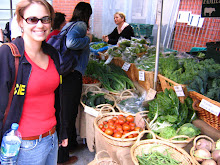
Tonight for supper I ate baked wild salmon, mashed sweet potatoes and sauteed kale with blueberries and yogurt for desert, topped off with tea. I am literally bursting with micro-nutrients. All these foods just happened to be what I was craving for supper, and they all just happen to be available locally. (More on how the salmon is local in a minute.)
All these foods have also been identified as "superfoods" by one dietetic association or another. This just means that these foods will cure what ails you, namely cancer. Crammed full of quaint (or scary) sounding nutrients like "flavonoids" and "carotenoids" these foods have everything you need to live forever. Eating well never tasted so good. This food is "good to think" too, to borrow from anthropologist Levi-Strauss, because it's come from local, organic sources.
I know, I know, you're saying, I get the sweet potatoes, but wild salmon, in Georgia? Come on. Well, climate change has not brought salmon to Georgia, but Athens Locally Grown has. A local family goes up to salmon country in Alaska and brings back the catch to sell here through ALG. While it's not local in the strict sense of the word, it does a lot of the work that "local" consumption/production does.
We buy local because it completes the three legged stool of justice--social, economic and environmental--in sustainability. It is a complete and functional system within which people are compensated fairly, social capital is built through direct connections, and the ecology of the environment is protected to the greatest extent that it can be. Buying direct is almost as good as buying local when it provides income to a family business and doesn't exploit workers or treat animals inhumanely. And let's face it, the salmon I just ate wasn't going to live a long peaceful life into its reclining years. It was likely heading directly to death after spawning in the river in which it was caught. The ecological piece is obviously lacking in this purchase, since this food came from more than a thousand miles away from here. That part troubles me enough to keep this food a luxury, not a staple. (This also makes me want to cry, or move to Alaska).
As I have found in my research on fair trade and organic food products, the interference of middle-people creates a lot of the problems in our current food system. (And the minor detail that we have to *buy* food.) When food is for sale, and lots of people get a cut, the least powerful actors take the biggest hit. In the case of organic bananas, these are Haitian workers who have little more than the shirt on their back. In the case of organic produce in the United States it is migrant workers in the same situation, who often work for less than minimum wage.
The best way I see to work out this food puzzle is that I have to eat healthy, and I have to eat righteously, which means eating with ethics and with an eye to justice. This means, that I can't place animal lives above human ones. No way. I'll eat a lot of animals before I knowingly consume something (like a banana) that puts workers lives at risk and permanently erodes their life chances in the same way that slavery has and still does. Fortunately there are some good options for eating healthy food that doesn't come at the expense of human lives. Even if it happens to come from across the continent, I'll take it.
The beauty of all this lies in the fact that these locally produced and directly traded foods are *the healthiest* foods on the planet! I didn't buy any of these things because I knew they were good for me. I bought them because they were delicious and righteous. The fact that they will make me live forever is just the blueberry on my yogurt.
Live, eat and love righteous.
Sunday, February 6, 2011


Tuesday, January 25, 2011
Back to Local Chow
Hi Friends and Followers!
Now that I am home for awhile in Georgia and eating locally, I'm going to start posting to my other blog. You can find it at localchow.blogspot.com.
See you there, and thanks for following!
Amy
Now that I am home for awhile in Georgia and eating locally, I'm going to start posting to my other blog. You can find it at localchow.blogspot.com.
See you there, and thanks for following!
Amy
Monday, January 24, 2011
One Chicken=Ten Meals
 It’s good to be home. I enjoyed my travels so much, but I am so grateful for my own bed, a closet (instead of a backpack) and my roach and frost-free bathroom (southern and northern hemispheres, respectively) really close by. I am especially enjoying my kitchen. After enjoying the cuisines of the world for the last 7 months, I am reveling in the chance to create my own cuisine again. This past week I have spent restocking my larder and buying out the stock of Athens Locally Grown. There is NOTHING like local food, and I have missed Georgia’s local food so much. Kale and sweet potatoes top my list and I’ve been getting my fill of them this past week.
For one reason or another, I’ve been eating a mostly vegetarian diet for the last several months, and I was really looking forward to getting back to some high quality, delicious pastured and grass-fed meats. Everyone who thinks about food at all approaches the problem of eating meat from a different perspective. Some go vegan. Others think cheese and eggs from factory farms are okay but killing animals is not. My own approach to this is that meat production and processing when done humanely on pasture by small-scale organic farmers is the most sustainable, healthful and ethical answer to the problem of getting the requisite amount of protein in my diet. Protein from animal sources (as opposed to plants) is critical to me because I have juvenile diabetes. Animal proteins reduce my insulin requirements and delay metabolism of carbohydrates without adding extra carbohydrates the way grain or legume sources do. A balanced diet is the only diet for my particular body.
There are some other low carb protein options, but each comes with its own serious downside. Soy based proteins come wrapped in plastic from 1000s of miles away and carry the risk of high levels of phytoestrogen exposure if over-consumed. (Read, if this is your only protein source, you are overconsuming). Plant monocultures are also devastating to the ecology of any place, and you better believe that even your organic tofu, soy milk and seitan come from monocropped sources. It is not hard to imagine that many animals whose destiny was never someone’s plate (butterflies, birds, fish, fungi, bacteria, worms…) die from the production of a serving of wheat, rice and other grains.
Eggs and cheese have their own ethical problems. Chickens in factory farms are tortured, imprisoned and poisoned for their eggs, as are the cows and calves that produce the milk and rennet required for your industrially processed cheeses. The humane slaughter of a chicken for a meal is way more ethical in my mind than eating eggs or cheese which were extracted through the living death of animals. Locally produced eggs and cheese usually don’t have these issues but this is an expensive option at $15/pound. I have also found that a steady diet of eggs and cheese also wrecks havoc on my cholesterol levels. Strangely, a diet of varied pastured meats, including a lot of bacon (go figure) puts my good cholesterol off the charts and my bad cholesterol in the basement. I volunteer to be a research subject should anyone want to find out why. But I think I know why. When grains form the basis of a diet, it often leads to high cholesterol levels in you or the critter who is eating them. Pastured beef cattle, pigs, sheep, goats and chickens often subsist solely on grasses, legumes and other forage, and so have very low levels of cholesterol themselves.

The killing part is still a thorny issue for many. Having been raised on a farm where my playmates became dinner more often than not, and coming from a long line of farmers who did their own butchering and processing after giving their animals a beautiful life and ultimately a purpose to provide for them, makes this a less abstract issue for me. I don’t want to eat my dog or my horse, but they aren’t in my life for that purpose. When I bring animals to my farm with the purpose of having them perpetuate my chain of being, it seems that the only way forward is to give them a natural and humane life and death.
I trust that the farmers who raise meat for me give their animals this. I also know that no one was exploited or poisoned to produce this food and my money goes to the farmer who did this for me, not to some nameless faceless corporation. I also know that small-scale diversified pastured animal production fits beautifully in a variety of ecological niches here in the U.S., and cows, goats, pigs and chickens are often beneficial to diversity and health in many ecosystems. This food also comes from somewhere in my immediate geography and this has benefits beyond the environmental. I boost the local economy and foster social relations at the same time I lower my carbon footprint. I can’t do that with grains, not here, not anywhere (only exception is Minnesota with wild rice, which may be the world’s most perfect food).

Since my body won’t have my diet any other way, I choose this path with my eyes wide open. I give thanks for the sacrifice of the animal who provides me with life, and offer my best love, skill and care in the preparation and consumption of the food, knowing full well that I have taken life for my own. It is a sacrament dedicated to life, not just a meal.
This week, I bought a pastured chicken from Greendale Farms. It was my first taste of chicken in 8 months, and I had plans for all my favorite meals. First I roasted the chicken rubbed with a garlic-herb butter that I made myself from local cream. Then I made stock from the bones and made a sweet potato and kale chicken soup for the freezer to be pulled out when I don’t have time to cook. For lunch, I had leftover root vegetables and chicken slathered in gravy from the pan drippings with some steamed local baby broccoli heads. Tonight I am making chicken and wildrice hotdish—a favorite of mine from childhood. One chicken, four different recipes; at least ten different meals. One chicken, one thriving farmer, one local place, one intact ecology. One chicken, one sacrifice.
I won’t convince anyone already convinced that their way is right, and that is not my intention. It’s just one answer to a multitude of questions about how we do this thing called life. For me and my life, this is the answer and the way for me. Come over for dinner if you want to join me.
Think well, live well, be well.
Tuesday, December 7, 2010
Fat Babies
 There is a narrative of poverty about the Dominican Republic, perpetuated by people like Angelina Jolie that most people accept as par for the course in “developing countries”. I do not dispute that people here are poor, and to be sure, there are people here, like everywhere, who live in conditions of grinding poverty and desperation. I would also add that a lot of those living in poverty here are Haitians, whose struggle for existence is exacerbated by lack of documentation and unreliable work visas. But, poverty has many faces. One of them is dignity. Another is perseverance. Another is the strength of women and families.
I questioned my own assumptions about poverty and this place when I first came in 2007. I saw things in the rural areas that surprised me—well-fed animals, neatly swept yards, freshly painted houses and lacy curtains waving in the windows. But it was the fat babies that really turned my head—then and now. Everywhere we go, we see fat babies waddling around, and it makes me really happy for lots of reasons. One reason is that infant mortality is usually a result of malnutrition, and this is also related to maternal malnutrition. The fact that we see a lot of fat babies suggests that both mothers and babies are getting enough food—which is usually not the case in poor populations.

I puzzled about this for a bit, and wondered if maybe I was just seeing what I wanted to see, or rather, just had my head turned by cute babies, until I ran across a very interesting statistic. Almost a quarter of the world’s children under five years old are underweight. The average percentage for the Caribbean and Latin American region is 8%. The percentage for the DR is 5%. So I was right, babies here—are at least statistically fatter than they are elsewhere. But why? The DR is slightly below the world average in terms of income (using purchasing power parity as a measure), as has an average annual income per person of around $8000, vs $10,000 for the world average. This on par with the rest of the region, which have (in some cases astonishingly) higher numbers of underweight children (15% for Ecuador). The DR also has the same income per capita as Thailand, but they have rates of underweight children closer to the world average (20%). If it’s not income, then what is it?

I would like to suggest that it is because women are the main breadwinners and heads of household here. I know this is paradoxical, and flies in the face of conventional wisdom. It is well documented that female headed households are generally poorer than male-headed households. But what I see here is that female-headed households have complex relations with other women in female-headed households, and that a reciprocal social economy revolves around children that prioritizes sharing resources, including food. For example, in our guesthouse, our housemother, AnaJulia is a single mother and she regularly babysits (for no money) for her sisters, sisters-in-law and other female neighbors while they work or go to school. She also regularly feeds a large extended family every time they visit. Roosters and rum (the provenance of masculinity) do not compete for resources in these households, and women in the DR regularly forsake relationships with men because they have failed to support their children. Tellingly, the countries with the highest levels of underweight children (Bangladesh, Yemen, Ethiopia) are also those countries where women have the least amount of autonomy, mobility and control over their bodies.
I don’t know if I’m right or wrong, and I probably won’t pursue the question any further than this. I’m just happy to see fat babies, and I hope to keep seeing them for a long time to come. I’m also happy to see the ways in which people cope and prioritize in the face of scarce resources, and turn the narratives of poverty and hopelessness into narratives of dignity, resourcefulness and strength.
Casabe Cottage Industry
 The high point of today was a trip to a home-scale casabe factory. Casabe, which is made from yuca (also known as cassava or manioc) is a staple food in the Dominican Republic. Moncion happens to the be the casabe capital of the DR--maybe even the universe. There are several large scale factories here, but we drive by a home-scale factory at least twice a day. Today, we decided to stop and see how they do it. Yuca originated in the Caribbean, and has since spread throughout the world, via colonialism. It takes a long time to grow (18 months), and resembles a small tree. The root is waxy and brown and tastes a bit like a potato when boiled. Casabe is made from the crushed yuca root.
 There are several stages of washing, crushing, straining, pulverizing, sifting, etc. before it becomes a kind of lumpy powder. This dried powder is spread inside cast iron rings on a wood fired griddle and roasted until it gets crispy. More yuca root powder is added, and the casabe is turned to cook on the other side. When done (a process that takes a few minutes) the casabe is stacked, cut (with a bandsaw!) and wrapped for sale.
 Mechi, the woman who owns this factory, sells her product mostly on the "Road to Moncion" but also in Mao (the closest large town). She was delighted to share her very fine product with us and sent us home with a couple freshly wrapped packs for the equivalent of a couple dollars. The price of food continues to rise due to CAFTA-DR (Central American Free Trade Agreement), the consequent increase of food imports and the decline in the viability of food production in Dominican Republic. As we are finding out, the rising food prices are causing a tremendous amount of anxiety among poorly paid banana workers.
I hope that small-scale, home-based production of indigenous and locally-produced and consumed foods can remain viable in a rapidly changing economic situation. Indeed, given what we are finding out about the impact of globalization here, it may be the only kind of enterprise that does. Or dare I say, should...
Friday, December 3, 2010
On Chickens and Roads
 Chickens are a rather important (and at times fairly irritating) part of the social economy here in Moncion. Right now, as I sit in my "office" on the porch of our guesthouse, I am watching the neighbor train his roosters for fighting. This involves a practice fight (traqueo) between his various roosters and consequent selection of a few who are taken away. My guess is that a cock fight is in the works for this evening or weekend. There is a constant din of crowing throughout the town of Moncion, and the sound of it pulses across the valley all day and most of the night. As we inadvertently determined via an interview recording a rooster crows every five seconds in our neighborhood.
The roosters of Moncion only take time off from crowing between the hours of 7 pm and 3 am, which is now when I sleep. There must be thousands of roosters here, which is an indication of the role cockfighting plays in the entertainment "industry" here. It's a blood "sport" during which roosters often fight to the death (and then are eaten by the crowd), and it has huge social significance for the construction of masculinity here and in the wider Caribbean region.
 But...if you think the roosters have a terrible fate, consider the fates of the hens. The Dominican Republic has adopted much of the North's industrial models of farming, and just up the road there are several chicken houses. Whether they are layers or broilers is not clear, but what is clear from menus and our meals in the guesthouse, is that eggs and chickens are a staple food for Dominicans. What is also clear is that these chickens live short, miserable lives crammed into cages just so we eaters can have cheap food, and those farmers can make money. (Incidentally, livestock farmers have the nicest houses in Moncion).
After our housemother AnaJulia made Erin and I (industrially produced) eggs for breakfast five days in a row, we began to worry about our health and the impact of our "choice" to eat these eggs. And so we took matters in our own hands. One day, I saw a woman on the beautiful "Road to Moncion" (a book I will write someday) selling small, brown eggs in the shade of a small stand. I am not kidding when I say I slammed on the brakes, almost got us flattened by a truck and backed into a tree just to get me some of those eggs. Turns out the hens are housed in wooden cages, but out in the open air, and they probably live lives a lot like the hens in my own backyard. The hens belong to the "sister of Emelita" and the eggs they produce are for sale along with sweets, cake and casabe most days of the week.

Even though AnaJulia has three sweet hens and a Foghorn Leghorn rooster in her backyard, she still buys the white eggs in the colmados (small local groceries). We weren't sure how she would receive our donation, and haven't explored the issue yet, but I suspect that she thinks we want the industrial products. We have slowly and gently been steering her towards the idea that we actually *like* to eat local fruits and vegetables. (We both have been having green vegetable fantasies...). This seems to mystify her for the most part, but she does her best to please us, no matter how weird our tastes might seem.

While the roosters and the layers of Moncion have uncertain and often horrible fates, the "wild chickens" of Moncion lead lives that most chickens would envy. They are literally everywhere, in all shapes, sizes and colors. They bring back fond memories of my own little Banty chickens, and it makes me happy to see livestock freed from the bonds of human desires for profit, pleasure and captivity.
So to answer the age old question, why did the chicken cross the road? Because, here in Moncion, it could.
Monday, November 29, 2010
Re/Displacement
 Thanksgiving used to be my favorite holiday. Any holiday premised entirely on cooking and eating is my kind of party. But, after encountering indigenous people and the remnants of their civilizations, all over the world (Adivasi in India, Anishinabe in Minnesota and Taino in the Caribbean) who have been pushed off their land by colonizing populations, I have lost my appetite for this particular celebration. In the runup to the holidays in the U.S., it’s easy to overlook the foundations of this holiday, and the tragic aftermath of western contact in the Americas.
Being in the Dominican Republic over this holiday, and having just left White Earth Indian Reservation, I was more than usually conscious of the impact of European contact and settlement in the western hemisphere. Colombus landed here first, and his brother, Bartholomew got the loot (slaves, land, gold, etc) for the Spanish crown. The Taino, not having immunity to European crowd diseases died in waves of epidemics. Those that did not die immediately were drafted as laborers for the colonies and were worked to death. African slaves were imported to work the sugar cane, and the children of Spanish plantation owners and African slaves now compose the population of most of the D.R. The only Caribbean island with any remaining native population of Taino is the island of Dominica—which is now an eco-reserve for tourists and the setting of the Pirates of the Caribbean films.
This Thanksgiving, Erin and I were staying in the house of AnaJulia and her daughter AnaMaria. Their house is our home base for banana farmer interviews in the region. For obvious reasons, Thanksgiving is not celebrated here, and given that we missed our families, we asked Dona Julia to cook us a special (vegetarian) meal to be shared in the afternoon. She knocked herself out! We had two kinds of rice (yellow and white), the typical Dominican tomato-based bean stew, fried sweet plantains, stewed eggplant, stewed squash (tayote), potato salad, green salad and fresh fruit. The whole meal was traditional Dominican food--minus the meat—which is a huge part of almost every meal here. Dona Julia joked that she bought every vegetable available in Moncion for us. We ate really well, and we felt pretty lucky.


We also felt pretty inspired. Next Thanksgiving, instead of gorging ourselves on food from factory farms in a macabre facsimile of the imagined and distorted origins of this holiday (see Eating Animals, by Jonathon Safran Foer), why don’t we honor the memory and legacy of indigenous people, and their agri-cultures in a conscious way by incorporating wild foods and local foods into our Thanksgiving meals and share these meals with a wider community? Why don’t we dedicate Black Friday as a day of service to rectifying the legacies of colonialism instead of a day of indulgence? Why don’t we organize ourselves to help return land to the landless in whatever way we can? We cannot make up for the sins of our forebears, but we can definitely stop being part of the problem. Start making plans now!
Subscribe to:
Posts (Atom)